Thursday, 8 November 2012

Palimpsest

The Kaleidoscope as Palimpsest


http://www.thegenxmom.com/hippies/index_files/kaleidoscope.html

Here is some narrative which exemplifies the sort of ambiguity of literal narrative that I believe we live in, and how we some how make sense of this.


Going back to my original adventure into Datamoshing process; where i was once describing the chaos of media that we are exposed to, it seems now I am seeing clarity in this chaos, Like the Mandelbrot there is a simplicity to its design, a beauty in the Kaleidoscopes pattern.


Saturday, 3 November 2012

Clifford Stoll

"All truth is one in this light
May Science and Religion en devour here for the steady evolution of mankind
From darkness to light, form narrowness to broad mindedness, from prejudice to tolerance
It is the voice of life, which calls us to come and learn."


Sunday, 28 October 2012

St Sepulchre Church Exhibiton

This summer, some of the then second year students managed to aquire space at the loval St Sepulchre church. Having applied to show my work in the exhibition i was accepted, and so began the process of helping set up the show. The two pieces I presented can be seen below.


Here is an extract from an interview about the pieces:

 Some photos of the church venue:


Here are a couple of my work hung:


Here are some group photos, the first of the exhibiting artists and student organizers  the second also including the mayor, and members of the church staff:


Friday, 26 October 2012

Becomings and Ouroboros

Becomings

I came across a book in the library titled 'Becomings: Explorations of Time, Memory, and Futures' by Elizabeth Grosz. Time and memory I have been considering though my work since the beginning of the term however the future has escaped me so far.

"Determinism annihilates any future uncontained by the past and present" p.4 so here in the books introduction Grosz is highlighting that the everyday definition of time as a vector or arrow, pre-supposes that the future is inherently predictable in relation to the past/present.

In this section of the book on page 86 Grosz considers the 'glace' as the view of life in the present, without preconception, but pure unfiltered momentary viewing.

"Unlike any arrow, this shot (the glance) does not simply go forward to its target, following a one-way trajectory that, once completed, lapses into nonbeing or at least nonactivity. Instead, the glance loops back onto the subject who emitted it; it folds back on the subject, coils over onto this subject, falling back onto it. . . . The clearest case in point is glancing at oneself in the mirror. Here I start by looking out from myself; taking my glance with me outward, i send it before me into the mirror, where I see myself glancing at myself, catching myself in the act, as it were. No sooner does this happen, however, than my glanced-at glance returns to me and is absorbed by the very face that sent it out in the first place: it folds back over this face, rejoining it at its own surface, as if to acknowledge this face as its own progenitor. Yet the glance returns to me not simply as to the same self, but to a self augmented by its own looking "

In this describes a sort of duality with the present and the past, that the two unfold simultaneously. Bergson talked in his own terms about time and the mirror:

"Pure Memory is to perception that which the image appercieved behind the mirror is to the object placed before it. The object is touched as well as seen: it can act on us as we act on it; it is pregnant with possible actions, it is actual. The image is virtual and, although similar to the object, incapable of doing what the object does. Our actual existence, insofar as it unfolds in time. is thus doubled with a virtual existence, with an image in a mirror." from L'energie Spirituelle, by Bergson.


This takes me back to my considerations of Narcissus in a previous post HERE

The Ouroboros

The Ouroboros, The snake that devours its self, has appeared in may different cultures and has resembled through varying themes an illustration of unity. Here is a look at the symbol and its significance.

Here is another perspective that considers Ouroboros in relation to seemingly separate observations.


Like the snake the earth appears to be devoured and re summoned in its cycle of darkness and light.

Guido Cagnacci, Allegoria della vita umana, c.1650


The allegory of human life by Cagnacci uses the Ouroboros as a symbol in conjunction with the skull and flower representing creation and destruction, life and death, the hourglass symbolizing temporarily of human life.

Thursday, 25 October 2012

Reading Around My Work

Hello Library, warm, secluded, and quite. Today I am doing some reading around the concerns of my work; the relationship between time and memory, and the nature of presence.

'Present Pasts: Urban palimpsests and the politics of memory' by Andreas Huyssen

"Even now, when i try to remember . . . , the darkness does not lift but becomes yet heavier as i think how little we can hold in mind, how everything is constantly lapsing into oblivion with every extinguished life, how the world is, as it were, draining itself, in that the history of countless places and objects which themselves have no power of memory is never heard, never described or passed on." W.G.Seabald, 'Austerlitz', p.24

"The boundary between past and present used to be stronger and more stable then it appears to be today. Untold recent and not so recent pasts impinge upon the present through modern media of reproduction like photography, film, recorded music, and the internet . . . The past has become part of the present in ways simply unimaginable in earlier centuries. As a result, temporal boudnaries have weakened just as the experiential dimension of space has shrunk as a result of modern means of transportation and communication."

The section titled 'The hypertrophy of memory' proposes that this compression of our history and how we identify with history, as if we are, socially, culturally, and individually, transcending a paradigm of association with the past and more an understanding of the past as ever informing the present, through the present. In this sense there is an instanuity in our recognition of the present, something which is maybe more accurate to the nature of human perception. relate my statement that "memories we have to remember aren't memories at all. It is the memories tat live through us in the present which are real."


Rate of flow

The concept of "time passing" can be considered to be internally inconsistent, by asking "how much time goes by in an hour?" The question, "how fast does time pass" seems to have no satisfactory answer, in which answers such as "a second per second" would be, as some would argue, trivial and thus false. In addition, even if we do accept the above answer, then the statement "a second per second" can be expressed as a fraction which is always equal to 'one'. But this 'one' has no meaning beyond being a number and is thus also the wrong kind of answer. Therefore, the argument goes, the passage of time is nonsensical.
There is a major problem though in that the question of time is no different from space. We can similarly ask, "how much space is contained in a meter?" — and face a similar objection. http://en.wikipedia.org/wiki/Eternalism_(philosophy_of_time)

In The Unreality of Time, J. M. E. McTaggart divided time into an A-series and a B-series, with the A-series describing events in absolute tensed terms (past, present, and future) and the B-series describing events in terms of untensed temporal relations (before and after). He also added the notion of a "C-series", a series that has an order but with no notion of time, like a series of letters.
      (series of letters like an un-regimented series of events is similar to how i believe we draw our sense of self and experience time through the self. We tend to only remember the important events, irrelevant of how far they were apart. How does this then relate to my suggestion that our memories live through our present actions; the unconscious self defined by past events, or the conscious self who is aware of this pre-determination. This then brings into question free will, and potentially how only through being conscious of the present moment and our actions in the present, can we be free to alter our actions and ultimately the future due to the inherent relationship between our learned behaviors  (preconceptions) and our perception. Though my previous statement exists within the 'A-series' framework, could it not be reconsidered in relation to the B series; in so much as, the past and the future can be plotted on some form of trajectory in the established understanding of sociology and the predictably of humans within given environments and under specific stimulus. Considering that B-theorists believe that the past, present, and future are equally real, I have to bring up the 'Many worlds' interpretation that every possible scenario of an event is as real as the other; this has reference to the nature of quantum mechanics; however it is both relevant to this discussion objectively but irrelevant to our human experience of life as I am concerned. The point I am trying to make is that we as humans exists within the fourth dimensional of space-time. Interestingly, it seems that our profound ability to remember and plot events in time is both the what sets us free from the unconscious cyclic nature of existence and yet our self absorption with the temporarily of life has lead to us creating a system where we try to calculate the speed of time in years, divided into months, to minuets, and seconds. How can we transcend this prison of time. Huyssen Suggests the 'Hypertrophy of memory' and in this maybe there is a portal. As we move ever closer to the instantaneous; the ability to share and communicate with increasing congruence with the present. We are becoming ever more interconnected; and through this process i believe that the self is becoming dissolved, just as our identification with the past is becoming more difficult, the separations between now and then. I equally see potential that separations between the self and the other will be transmuted. There is countless evidence to propagate this eventuality within our history and in such our nature. Anytime in history when one person has intended to rule assume power over another it has failed, and yet we all seek an affinity with the other, an essential connection that can be seen but is not limited to the sexual bond between male and female. Our tribal heritage is not of coincidence and does not still exist within the world today by coincidence  As the pressure of globalization increases the consistency of egoistic collisions, ideals are forced to dissolve into one another. As the collective gravity of matter formed the stars and planets, we are so heading for a dissolution, whether this will crush us under its weight or transmute us into a core is unclear. These considerations of time translate in scale, if we can release the binds of the past and so the future, we can see the present as a palimpsest of what has and may come to pass, though this image is shrouded in entropy, it is our unique potential to decipher these seemingly ambiguous observations and be imbued and informed through present consciousness. Magic.


Schrodinger's cat

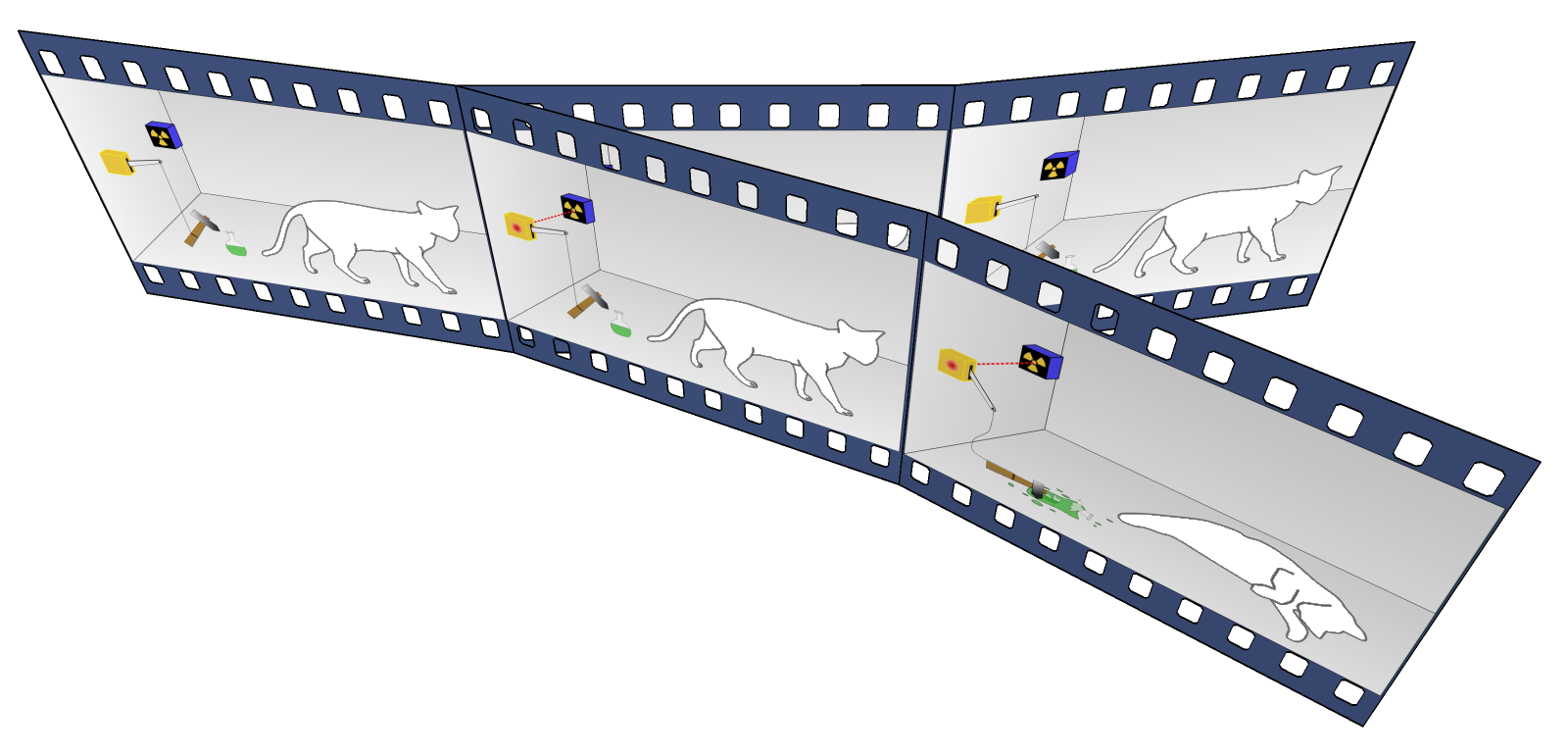
Speaking on the relevance of the quantum mechanics and the 'Many worlds theory' I believe that Schrodinger's though experiment has much to offer.
Schrodinger wrote:
One can even set up quite ridiculous cases. A cat is penned up in a steel chamber, along with the following device (which must be secured against direct interference by the cat): in a Geiger counter, there is a tiny bit of radioactive substance, so small that perhaps in the course of the hour, one of the atoms decays, but also, with equal probability, perhaps none; if it happens, the counter tube discharges, and through a relay releases a hammer that shatters a small flask of hydrocyanic acid. If one has left this entire system to itself for an hour, one would say that the cat still lives if meanwhile no atom has decayed. The psi-function of the entire system would express this by having in it the living and dead cat (pardon the expression) mixed or smeared out in equal parts. It is typical of these cases that an indeterminacy originally restricted to the atomic domain becomes transformed into macroscopic indeterminacy, which can then be resolved by direct observation. That prevents us from so naively accepting as valid a "blurred model" for representing reality. In itself, it would not embody anything unclear or contradictory. There is a difference between a shaky or out-of-focus photograph and a snapshot of clouds and fog banks.
—Erwin Schrödinger, Die gegenwärtige Situation in der Quantenmechanik (The present situation in quantum mechanics), Naturwissenschaften
(translated by John D. Trimmer in Proceedings of the American Philosophical Society)
I have highlighted in orange specific phrases which hold presence in my current experiments with condensation of time and the abstracted ambiguous images that are produced. here's an example from my previous post:

Many Worlds theory

In 1957, Hugh Everett formulated the many-worlds interpretation of quantum mechanics, which does not single out observation as a special process. In the many-worlds interpretation, both alive and dead states of the cat persist after the box is opened, but are incoherent from each other. In other words, when the box is opened, the observer and the already-dead cat split into an observer looking at a box with a dead cat, and an observer looking at a box with a live cat. But since the dead and alive states are incoherent, there is no effective communication or interaction between them.


More to read:
Art & Time (704.949529)
Phenomonology of Perception by M.Merleau-Ponty
The Anthropology of Time by Alfred Gell
Becomings by Elizabeth Grosz

Thursday, 18 October 2012

Wash


     Below is a link to newest product of my experimentation with a video process I have been exploring in relation to my interest with memory and the human experience of temporality.


     The act of washing has roots in the religious, cleansing of the spirit. Given my considerations for the nature of the self, and how we identify with ourselves in time present, and past through memory; the video appears to be dissolving the image of the self as formal portraiture, with each consecutive wash transforming the original form. In this very way I find correlations between this video and the video works of Bill Viola, in specific the piece as described by the artist below. Using the process of washing as imagery to present a change in state.


     Where on one hand, above, I have proposed that the process is a reduction in form, there is room to consider that the repetition creates an accumulation rather then a reduction. Though this is contradictory to the nature of the video process I feel it does offer an insight to the works gravitas. 


     As the process repeats it can be seen, that like Bruce Nauman's 'Art Make-Up' (above), in appearance an application of colour to the work. Though in process I know this not to be the case, as the only stimulus that exists within the video is the initial image frame, with no further external reference, only motion remains; all of the colour distortion that occurs is essentially a reduction from the source image colours. That being said I do believe that within the works concept there is a form of accumulation that can be brought into question, the accumulation of obscurity; as the act regresses from its original form of conception, its moment of origin; entropy begins corroding the form. The building ambiguity of the work culminates at the videos end, as the portrait becomes evermore ethereal.

     I  want to conclude that this deformation through process is my intention to suggest our inability to ever truly experience the past as it happened in the then present. Eckhart Tolle's claims on this are of great influence to me, referencing 'The power of now'. There is a certain irony that arrises in the this debate between the notion of the self and our memories of ourself. I am proposing in duality, that whilst the past offer use such ambiguity  we simultaneously draw the egoic self from that same place. In a sense this video is a proposition of our fallibility, of the fundamentally flawed uncertainty of any definite understanding of the self drawn from the past. I suggest that regardless of our re-imaginings, our memories live through us in the present regardless. The only way to truly view the self is in the mirror of consciousness in the now.

Wednesday, 17 October 2012

Narcissus, Aten, Benoit Mandelbrot

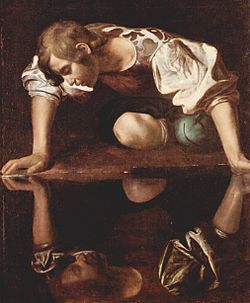
     In Greek Mythology Narcissus was a hunter from the territory ofThespiae in Boeotia who was renowned for his beauty. He was exceptionally proud, in that he disdained those who loved him. Nemesis saw this and attracted Narcissus to a pool where he saw his own reflection in the water and fell in love with it, not realizing it was merely an image. Unable to leave the beauty of his reflection, Narcissus died.


File:Michelangelo Caravaggio 065.jpg
'Narcissus' by Caravaggio

     The story stands as a metaphor for self absortion and the corruptive nature of the ego. In relation to my work I am considering how we identify the self and relate to our 'self'. 

     Oscar Wilde created a variation of this story which continues after his death. He says that when Narcissus died, the Oreads, who were goddesses of the woods, came and saw that the sweet waters of the pool had changed into salt tears.

‘Why are you crying?’ asked the Oreads.

‘I’m weeping for Narcissus.’

‘We do not wonder that you should mourn for Narcissus in this way,’ they said. ‘After all, we could only run after him through the forest, but you could gaze on his beauty from close to.’

‘But was Narcissus beautiful?’ asked the pool.

‘Who better than you to know?’ the Oreads replied, somewhat taken aback. ‘It was, after all, on your banks that he would lie each day.’

The pool was still for a moment. Then it said:

‘I weep for Narcissus, but I never noticed that he was beautiful. I weep for him because whenever he lay on my banks and looked into my waters, I could see my own beauty reflected in his eyes.’

     This version now bares the understanding of an ecology between the self, and the other. That we see our own nature and beauty, reflected in the other. In relation to the philosophy of human finitude the acceptance of the other is "fundamental" described by A.W.Moore in the essay Human Finitude, Ineffability, Idealism, Contingency. Toril Moi describes the realisation that "there are others" as a "traumatic discovery" in her essay From femininity to finitude: Freud, Lacan, and feminism, again (p.874)


Figure 1a. The Mandelbrot set illustrates self-similarity. As you zoom in on the image at finer and finer scales, the same pattern re-appears so that it is virtually impossible to know at which level you are looking.
Figure 1b. Mandelbrot zoomed 6x
Figure 1c. Mandelbrot zoomed 100x
Figure 1d. Even 2000 times magnification of the Mandelbrot set uncovers fine detail resembling the full set.
Aten is the disk of the sun in ancient Egyptian Mythology, and originally an aspect of Ra. The deified Aten is the focus of the monolatristichenotheistic, or monotheistic religion of Atenism. The tablet extract below shows hands extending upon the rays of the sun, which illustrates well the belief that human existence was somehow intrinsic to the sun, not only in symbiosis, but in essence also. Again there is an ecology with the other, however in this example, there is now fundamentally a cohesion of formality in being. 


Benoit Mandelbrot created the term Fractal Geometry, a visualition of mathematical formulae which generate patterns that are self referential. An understand of this relationsip between the micro and the macro intruiges me in relation to the belief that all tings are one, and binded by a universal force. Some call this god, the unknown.


In the abstract pattern above, someone has attempted to create an illustration of the sun god Aten. This image speak resoundingly for the connection that I am trying to establish with the Mandelbrot set. Reflecting upon my initial inquest into the story of Narcissus, I am suggesting that by accepting the subjective fallibility of the self (the ego) we can embrace the essential otherness that we share with all things, and which in that sense connects us all.